|
Viewing 10 - 18 out of 39 Blogs.
| Page:
|
2 |
|
|
|
The Wolf Pack Wolves belong to family groups called packs, they usually consist of eight to fifteen-members. The rare exception is what is popularly know as a "lone wolf", this wolf would most likely be the lowest member of a pack (the omega) that was driven out of the pack, if it is lucky, the "lone wolf" may find a mate and start a new pack. Wolf packs can have very large range (6 to 600 miles) 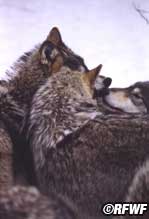 The alpha pair has the greatest amount of social freedom among all the pack members, but they are not "leaders" in the human sense of the term. The alphas do not give the other wolves orders; rather, they simply have the most freedom in choosing where to go, what to do, and when to do it. The rest of the pack usually follows. There are various subordinates, who dominate the omega. The omega is the lowest. It is the baby-sitter and usually more puppy than wolf. The alpha pair has the greatest amount of social freedom among all the pack members, but they are not "leaders" in the human sense of the term. The alphas do not give the other wolves orders; rather, they simply have the most freedom in choosing where to go, what to do, and when to do it. The rest of the pack usually follows. There are various subordinates, who dominate the omega. The omega is the lowest. It is the baby-sitter and usually more puppy than wolf.
(left) photograph ©Richard E. Flauto Wildlife Foundation In larger packs, there may be also be a beta wolf or wolves - a "second-in-command" to the alphas. In addition, one wolf typically assumes the role of omega, the lowest-ranking member of a pack. These individuals absorb the greatest amount of aggression from the rest of the pack, and consequently enjoy comparatively few individual privileges. While most alpha pairs are monogamous with each other, there are exceptions. An alpha animal may preferentially mate with a lower-ranking animal, especially if the other alpha is closely related (a brother or sister, for example). The death of one alpha does not affect the status of the other alpha, who will quickly take another mate. Usually, only the alpha pair is able to successfully rear a litter of pups (other wolves in a pack may breed, and may even produce pups, but usually they lack the freedom or the resources to raise the pups to maturity). All the wolves in the pack assist in raising wolf pups. Some mature individuals, usually females, may choose to stay in the original pack so as to reinforce it and help rear more pups. Most, males particularly, will disperse, however. 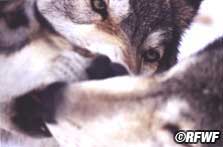 Rank order is established and maintained through a series of ritualized fights and posturing best described as ritual bluffing. Wolves prefer psychological warfare to physical confrontations, meaning that high-ranking status is based more on personality or attitude than on size or physical strength. Rank, who holds it, and how it is enforced varies widely between packs and between individual animals. In large packs full of easygoing wolves, or in a group of juvenile wolves, rank order may shift almost constantly, or even be circular (e.g., animal A dominates animal B, who dominates animal C, who dominates animal A). Rank order is established and maintained through a series of ritualized fights and posturing best described as ritual bluffing. Wolves prefer psychological warfare to physical confrontations, meaning that high-ranking status is based more on personality or attitude than on size or physical strength. Rank, who holds it, and how it is enforced varies widely between packs and between individual animals. In large packs full of easygoing wolves, or in a group of juvenile wolves, rank order may shift almost constantly, or even be circular (e.g., animal A dominates animal B, who dominates animal C, who dominates animal A).
(above/below photograph ©Richard E. Flauto Wildlife Foundation) 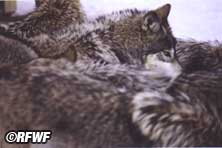 Loss of rank can happen gradually or suddenly. An older wolf may simply choose to give way when an ambitious challenger presents itself, yielding its position without bloodshed. On the other hand, the challenged individual may choose to fight back, with varying degrees of intensity. While the majority of wolf aggression is non-damaging and ritualized, a high-stakes fight can easily result in injury for either or both parties. The loser of such a confrontation is frequently chased away from the pack or, rarely, may be killed as other aggressive wolves contribute to the insurgency. This kind of dominance encounter is more common in the winter months, when mating occurs. Loss of rank can happen gradually or suddenly. An older wolf may simply choose to give way when an ambitious challenger presents itself, yielding its position without bloodshed. On the other hand, the challenged individual may choose to fight back, with varying degrees of intensity. While the majority of wolf aggression is non-damaging and ritualized, a high-stakes fight can easily result in injury for either or both parties. The loser of such a confrontation is frequently chased away from the pack or, rarely, may be killed as other aggressive wolves contribute to the insurgency. This kind of dominance encounter is more common in the winter months, when mating occurs.
Wolves will defend there territory, they work as a pack to harass larger animals like bears, although a pack of 12 were once known to kill a grizzly bear, most times if the animal runs away the wolves will not attack. Animals the wolf may come in contact with are: Coyotes - They will avoid wolves most times. but when encounters occur they are aggressive. Grizzly bears - Are known to eat wolf pups, wolves will chase away bears from the den area. Cougars - Although rare in nature, the cougar being a lone hunter is at a disadvantage in a fight with a wolf pack. Foxes - Foxes have been observed stealing from wolf kills, wolves have been know to steal fox dens, wolves have been known to kill foxes, though it is rare, more often than not they ignore these tiny predators, the exceptions is in the arctic region where wolves will usually kill a fox on sight. Ravens - One of the most fascinating relationships between animals is the one that seems to exist between wolves and raven. The raven, scavenger of food of all types, will often follow wolf packs in hopes of morsels of food. and wolves have learned to watch for circling ravens as a sign of possible food below. Dogs - Although wolves are physiologically capable of breeding with dogs, such crossed usually happen in captive situations, trappers tales of wild wolves mating with dogs is usually a campfire myth. Most encounters between wild wolves and dogs are aggressive in nature, it is only natural a dog would be a trespasser in a wolf's territory, small yapping dogs may be attacked as nuisances.
Communication Body Postures Wolves communicate not only by sound (such as yipping, growling, and howling), but also by body language. This ranges from subtle signals-such as a slight shift in weight-to the obvious, like rolling on the back as a sign of submission. Here are some other examples of Body postures: Dominance - A dominant wolf stands stiff legged and tall. The ears are erect and forward, and the hackles bristle slightly. Often the tail is held vertical and curled toward the back. This display shows the wolf's rank to all others in the pack. A dominant lupine may stare penetratingly at a submissive one, pin it to the ground, "ride up" on its shoulders, or even stand on its hind legs. Submission (active) - In active submission, the entire body is lowered, and the lips and ears are drawn back. Sometimes active submission is accompanied by a rapid thrusting out of the tongue and lowering of the hindquarters. The tail is placed down, or halfway or fully between the legs, and the muzzle often points up to the more dominant animal. The back may be partially arched as the submissive wolf humbles itself to its superior. (A more arched back and more tucked tail indicate a greater level of submission.) Submission (passive) - Passive submission is more intense than active submission. The wolf rolls on its back and exposes its vulnerable throat and underside. The paws are drawn into the body. This is often accompanied by whimpering. Anger - An angry lupine's ears are erect, and its fur bristles. The lips may curl up or pull back, and the incisors are displayed. The wolf may also snarl. Fear - A frightened wolf tries to make its body look small and therefore less conspicuous. The ears flatten down against the head, and the tail may be tucked between the legs, as with a submissive wolf. There may also be whimpering or barks of fear, and the wolf may arch its back. Defensive - A defensive wolf flattens its ears against its head. Aggression - An aggressive wolf snarls and its fur bristles. The wolf may crouch, ready to attack if necessary. Suspicion - Pulling back of the ears shows a lupine is suspicious. In addition, the wolf narrows its eyes. The tail of a wolf that senses danger points straight out, parallel to the ground. Relaxedness - A relaxed wolf's tail points straight down, and the wolf may rest sphinxlike or on its side. The wolf's tail may also wag. The further down the tail droops, the more relaxed the wolf is. Tension - An aroused wolf's tail points straight out, and the wolf may crouch as if ready to spring. Happiness - As dogs do, a lupine may wag its tail if it is in a joyful mood. The tongue may loll out of the mouth. Hunting - A wolf that is hunting is tensed, and therefore the tail is horizontal and straight. Playfulness - A playful lupine holds its tail high and wags it. The wolf may frolic and dance around, or bow by placing the front of its body down to the ground, while holding the rear high, sometimes wagged. This is reminiscent of the playful behavior executed in domestic dogs. 
Photograph (above right) from The Searching Wolf Communication through Scent 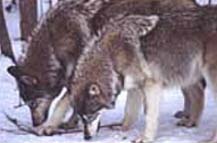 Wolves have a very good sense of smell Research shows wolves have been able to detect their pray at distances of up to 1.75 miles (3 kilometers), which they also use to communicate. Wolves mark their territory with urine and faeces. This is called scent marking. When "outside" wolves smell this, they know that an area is already occupied. Of course, their sense of smell also tells them when food or enemies are near. Wolves have a very good sense of smell Research shows wolves have been able to detect their pray at distances of up to 1.75 miles (3 kilometers), which they also use to communicate. Wolves mark their territory with urine and faeces. This is called scent marking. When "outside" wolves smell this, they know that an area is already occupied. Of course, their sense of smell also tells them when food or enemies are near.
(Above photograph ©Richard E. Flauto Wildlife Foundation) Communication through Sound - the wolf howl Wolves howl for several reasons. Howling helps pack members keep in touch, allowing them to effectively communicate in thickly forested areas or over great distances. Furthermore, howling helps to summon pack members to a specific location. Howling can also serve as a declaration of territory, as portrayed by a dominant wolf's tendency to respond to a human imitation of a "rival" individual in an area that the wolf considers its own. This behavior is also stimulated when a pack has something to protect, such as a fresh kill. As a rule of thumb, large packs will more readily draw attention to themselves than will smaller packs. Adjacent packs may respond to each others' howls, which can mean trouble for the smaller of the two. Thus, wolves tend to howl with great care. Wolves will also howl for communal reasons. Some scientists speculate that such group sessions strengthen the wolves' social bonds and camaraderie -- similar to community singing among humans. During such choral sessions, wolves will howl at different tones and varying pitches, which tends to prevent a listener from accurately estimating the number of wolves involved. This concealment of numbers makes a listening rival pack wary of what action to take. For example, confrontation could mean bad news if the rival pack gravely underestimates the howling pack's numbers. Observations of wolf packs suggest that howling occurs most often during the twilight hours, preceding the adults' departure to the hunt and following their return. Studies also show that wolves howl more frequently during the breeding season and subsequent rearing process. The pups themselves begin howling towards the end of July, and can be provoked into howling sessions relatively easily over the following two months. Such indiscriminate howling usually has a communicative intent, and has no adverse consequences so early in a wolf's life. Howling becomes less indiscriminate as wolves learn to distinguish howling pack members from rival wolves. Far across the tanana, a mile or two to the south of us, a group of wolves were singing. I call it singing, not howling, for that is what it was like. We could distinguish three, perhaps four voices - wavering, ascending in pitch, each one following the other, until they all broke off in a confused chorus. Their voices sank into distant echoes on the frozen river, and began again. A light and uncertain wind was blowing out there, and the sound grew and faded as the air brought it toward us or carried it away southward. It might have come across a thousand years of ice and wind-packed snow, traveling as the light of the stars from a source no longer there. John Haines; the stars, the snow, the fire website~www.wolfcountry.net~ go to the site to listen to the wolf howls.
Tags: Wolves, The Pack
Wolf Facts The wolf is a large member of the canine family. It is not known for sure just when the divergence occurred that split the ancestors of our domestic dog, C. familiaris, from the grey wolf, C. lupis, but it us thought to have occurred about four million years ago (see wolf origins section for more information). Appearance | Size | Teeth Paw Structure | Speed
Swimming Grooming | Play | Senses | Pack | Life span 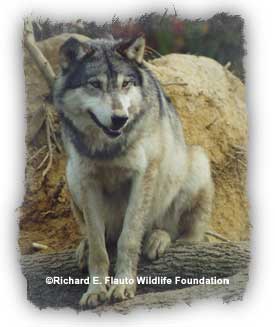
Early man was probably followed by a wolf like creature that scavenged on the remains of his kills. In time, the creature sacrificed his freedom in exchange for those remnants. The dog, for so the creature turned out to be, was not the only one to gain from the exchange. In time the dog learned how to help the man in his hunting, guarding the herds of other animals that the man domesticated, was sometimes used as a beast of burden and, at times, even protected man from other animals. The Wolf has developed the capacity to survive in the most inhospitable of climates. The wolves in the high arctic endure several winter months of perpetual darkness. Even in February when sun returns to the north, temperatures of -40°C and bitter winds are common. Other wolves are at home in the desert and the dampness of a humid Gulf Coast swamp. General Appearance back to top 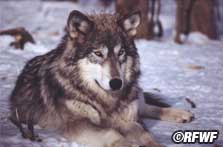 Although most wolves have basically grey coats, hence the common name, the coats usually have a lot of base yellow interspersed between the salt-and-pepper fey and black hair. Wolves anywhere can have coats that grade from almost pure white to jet black, although all of the arctic wolves are usually all white. Although most wolves have basically grey coats, hence the common name, the coats usually have a lot of base yellow interspersed between the salt-and-pepper fey and black hair. Wolves anywhere can have coats that grade from almost pure white to jet black, although all of the arctic wolves are usually all white.
(right) photograph ©Richard E. Flauto Wildlife Foundation Wolves are very intelligent creatures whose upright ears, sharp, pointed muzzles, inquiring eyes, and other facial features instantly convey this quality. Their heads closely resemble that of a german shepherd dog, although the skull is broader and more massive. Wolves also have ruffs of long hair framing the sides of their faces like sideburns. Size back to top Most of the adult grey wolves weigh in the vicinity of 75 to 125 pounds (34 to 56 kilograms). Males are usually larger than females by as much as twenty-five percent. There are authenticated records of male wolves weighing as much as 175 pounds (79 kilograms). As large as wolves are, they usually appear to much larger because of their long hair. In the winter coat, the hair on their back and sides averages 2 to 2.5 inches (5 to 6.3 centimeters) in length. Starting at the base of the neck, the wolf has a teardrop-shaped mane of hair that elongates into just a crest down the spine toward the tail. Over the shoulder, the mane is about 6 inches (15.2 centimeters) wide. The hairs in the mane are 4 to 5 inches (10 to 12.7 centimeters) long and are attached to erectorpilli muscles, which allow the hairs to stand on end, making the wolf appear even larger. 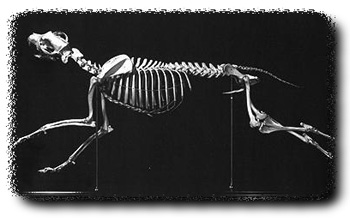
Extensive studies of the North American wolf species show between 50 to 70 inches (1.3 to 1.8 metres) in total nose-tip-to-tail-tip length. Of that length, one quarter is tail length. Wolves Stand between 27 to 31 inches (68 to 78 centimeters) high at the shoulder. Compared to dogs of the same size, wolves' chests are much narrower. Their legs are also longer in proportion to their body weight than are most dogs. Because of its narrower chest, the wolf's left and right foot tracks closer together than the dogs. Teeth back to top 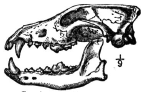 The wolf has very strong jaws. According to Barry Lopez in Of Wolves and Men, the jaws of a wolf have a "crushing pressure of perhaps 1,500 (lbs/square inch) compared to 740 (lbs/square inch) for a German Shepherd." The dentition of the wolf consists of twenty-two teeth: twelve incisors, four canines, sixteen pre molars, and ten carnassials and molars. The canines of the wolf are 1-inch (2.54 centimeters) long, strong, sharp, and slightly curved. These are the teeth used for grasping prey. The wolf does not chew its food, using its carnassials to scissor off a piece of meat that can then be swallowed in a manageable chunk. Having strong jaws allows the wolf to crush bones to get to the soft marrow, it also helps the wolf eat most of its prey leaving very little waste The wolf has very strong jaws. According to Barry Lopez in Of Wolves and Men, the jaws of a wolf have a "crushing pressure of perhaps 1,500 (lbs/square inch) compared to 740 (lbs/square inch) for a German Shepherd." The dentition of the wolf consists of twenty-two teeth: twelve incisors, four canines, sixteen pre molars, and ten carnassials and molars. The canines of the wolf are 1-inch (2.54 centimeters) long, strong, sharp, and slightly curved. These are the teeth used for grasping prey. The wolf does not chew its food, using its carnassials to scissor off a piece of meat that can then be swallowed in a manageable chunk. Having strong jaws allows the wolf to crush bones to get to the soft marrow, it also helps the wolf eat most of its prey leaving very little waste
Wolf Scull image from Clipart.com Paw Structure back to top 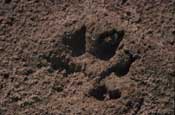 Humans are plantigrade, walking upon our entire flat foot, sole to heel. All members of the canine family, and the feline family too, are digitigrade, walking upon just their toe tips. Unless a wolf is lying down, the heel of each foot does not come in contact with the ground. The front feet of a wolf are exceptionally large. This is of great advantage to the wolf when it runs upon snow, as it allows greater weight distribution and more support to prevent the animal from sinking in as deeply when the snow is soft. Humans are plantigrade, walking upon our entire flat foot, sole to heel. All members of the canine family, and the feline family too, are digitigrade, walking upon just their toe tips. Unless a wolf is lying down, the heel of each foot does not come in contact with the ground. The front feet of a wolf are exceptionally large. This is of great advantage to the wolf when it runs upon snow, as it allows greater weight distribution and more support to prevent the animal from sinking in as deeply when the snow is soft.
(above right) Photograph from Clipart.com The wolf has five toes on each forefoot, but only four are actually needed. The fifth toe, corresponding to our thumb, has regressed. It is found up on the middle of the foot and is known as the dew claw. There are just four toes on each of the hind feet. Each toe pad is surrounded by stiff, bristly hairs, which act as insulation and also provides a better grip on slippery ice surfaces. The claws are strong and blunt because the tips are worn off by constant contact with the ground. These are used for digging and in gripping the earth while running, not for seizing prey. Speed back to top Wolves walk, trot, lope, or gallop. Their legs are long, and they walk at about 4 miles (6.4 kilometers) per hour, but can reach speeds of 35 mph during a chase. Their usual mode of travel is to trot, which they do at various speeds, generally between 8 to 10 miles (12.8 to 16 kilometers) per hour. Wolves do not run at full speed until they get close to their prey as possible. At that point, they make a high-speed chase to test the animal. Wolves can keep up this pace for hours on end and have been known to cover 60 miles (96 kilometers) in a single night. They have been clocked at speeds of over 40 miles (64 kilometers) per hour for a distance of several miles. Swimming back to top 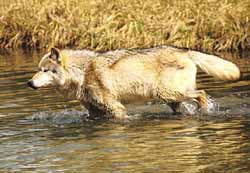
The wolf is very comfortable in the water, and does not hesitate to wade through icy streams or swim across short stretches of lake. In summer, wolves often bathe in streams to keep cool, and they will readily follow prey into water. (right) image from Clipart.com
Grooming Wolves have been known to wash mud from there coats in rivers and streams, wolves depend on thier thick coats in winter, so it is not surprising that they spend part of thier leisure time in grooming behavior. It is also likely that the grooming of other pack members helps reinforce the social bonds the tie the pack together. Two wolves will lick each others coats, nibbling gently with thier teeth to remove foreign matter. Reciprocal grooming is especially common during courtship. Injured wolves are intensely groomed by other pack members, providing both physical and mental comfort. Play back to top 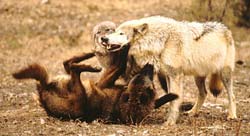 Wolves love to play, shouldering one another, bumping bodies together, flopping tails over each other's backs, and leaping up placing forepaws around other' necks. Play especially in pups, develops strength and hunting skills, and aids in establishing pack communication and hierarchy. The intention to play is often signaled by the gesture well known to dog owners of dropping the front quarters into a crouch position, with smiling face and wagging tail. Adult wolves stage mock fights, play chase, and leap on each other. The ambushing of unwary pack members is a favorite game. Wolves love to play, shouldering one another, bumping bodies together, flopping tails over each other's backs, and leaping up placing forepaws around other' necks. Play especially in pups, develops strength and hunting skills, and aids in establishing pack communication and hierarchy. The intention to play is often signaled by the gesture well known to dog owners of dropping the front quarters into a crouch position, with smiling face and wagging tail. Adult wolves stage mock fights, play chase, and leap on each other. The ambushing of unwary pack members is a favorite game.
Photograph (above) ©Clipart.com Wolf Senses back to top SCENT 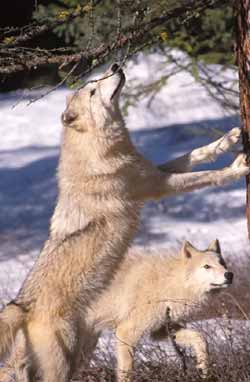 Scent plays a very important role in the life of the wolf, by smell alone wolves can locate prey, other pack members or enemies. It can tell them if other wolves were in the territory, if they were male or female, and how recently they visited. Photograph (right) ©Clipart.com The wolf has several specialized glands, one around the anus and another on its back about 3 inches (7.6 centimetres) in the front of the base of its tail. The scent from these glands is as individualistic as are out fingerprints and is used by that particular wolf as its personal calling card. These Glands are used as to mark boundaries and also to mark trails. These "Scent Stations" are often 100 yards (91 metres) apart. Scent plays a very important role in the life of the wolf, by smell alone wolves can locate prey, other pack members or enemies. It can tell them if other wolves were in the territory, if they were male or female, and how recently they visited. Photograph (right) ©Clipart.com The wolf has several specialized glands, one around the anus and another on its back about 3 inches (7.6 centimetres) in the front of the base of its tail. The scent from these glands is as individualistic as are out fingerprints and is used by that particular wolf as its personal calling card. These Glands are used as to mark boundaries and also to mark trails. These "Scent Stations" are often 100 yards (91 metres) apart.
Scent Marking The wolf use scent to mark territory, establish position of site of a kill and other factors within the pack. Urination Marking. Alpha males will use Raised-leg urination primarily, Female and subordinate males use the squat-position. Females wolves also scent mark less that males. The Alpha wolf will direct urine at stumps, rocks, or trees this marks the packs presents to the members of the pack and other wolves. Wolves from rival packs may mark over the existing scent mark to obscure its odor. The marks may also be used as a boundary or fence post acting as a direction system. Lone wolves don't use Raised-leg urination (captive wolves have been known to urinate in ponds or streams). Defecation Marking Defection may stimulate the anal gland and release hormonal secretions, wolves will sometimes leave scat at regular intervals on paths and hunting routes, these also act as visual markers to other wolves. Scratching and pawing Wolves have been known to paw or scratch the ground or trees, this may release odors from glands in the paws or as visual markers to pack members and other wolves. Sense of smell The sense of smell in the wolf is highly developed, as would be expected in an animal possessing numerous scent glands. The distance at which any scent can be detected is governed by atmospheric conditions but, even under the most favorable conditions , 1.75 miles denotes a particularly keen sense of smell. The wolves usually travel until they encounter the scent of some prey species ahead of them. They then move directly toward their prey in an effort to capture it. HEARING Next to smell, the sense of hearing is the most acute of the wolf's senses. Wolves can hear as far as six miles away in the forest and ten miles in the open. Wolves can hear well up to a frequency of 25 khz. Some researchers believe that the actual maximum frequency detected by wolves is actually much higher, perhaps up to 80 khz (the upper auditory limits for humans is 20 khz), also according to some naturalist wolves' hearing is greater than that of the dog. SIGHT Wolves also have keen eye sight and are quick to detect the slightest movement of anything in front of them. Being major predators, thier eyes are on the front of there heads, and they have probably a little less than 180-degree vision, unlike their prey species, which can see over 300 degrees of a circle. TASTE Investigation of taste are made difficult by the fact that the influence of smell often plays a major role in the way a food "tastes." It is known that canines possess taste receptors for the four taste categories: salty, bitter, sweet, and acidic. Felines on the other hand, do not respond to sweetness. The sweetness receptivity would be adaptive use to wolves, as sweet berries and other fruits do play a minor role in their diet. Pack Structure back to top Wolves live in family groups called packs. A pack is usually made up of a male parent, a female parent, their pups and a few other adult wolves who are the older brothers and sisters. The pack works together to hunt for food and to take care of the pups. Some members stay with the pack for life. Wolves can run up to 40 miles an hour and can easily cover 50 miles a day. It is highly likely that at one time or another the land your home is on was once the home of a wolf pack{greatest natural range of any mammal except humans} To learn more about the pack, Click Here
Life Span back to top In the wild wolves can live up to 13 years or more, in a protected wolf park or a controlled area of land, a wolf can live to be up to 16 years old. But most wolves usually live to be to around 8 years of age. The record wolf life span is about 20 years of age. Life in the wild is difficult for the wolf, with human population taking up more and more wolf habitat, and with those who would kill the wolf, a long life span is unlikely. In a controlled environment they can live longer because they are safe from the outside dangers of traps, snares,enemies and poisons. website~www.wolfcountry.net
Tags: Wolves
Wolves as hunters  Wolves kill and eat other animals for food. Depending on where they live, wolves live mainly on the meat from such animals as deer, moose, elk or bison. They also eat beavers,rabbits and even mice. They do not eat humans. Wolves are not a threat to humans!
(There is no documented account of a healthy wolf ever attacking a human.) Wolves are very shy around people and try to avoid them in the wild. 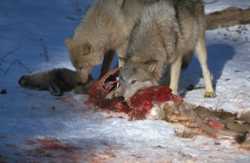 Wolves kill only to eat - to survive. Because wolves usually hunt for large animals, (although wolves are opportunistic and will eat smaller prey) they work together to catch their prey. Wolves will eat a healthy, strong animal if they can catch it.(Wolves need an average of three to ten pounds of meat each day). Wolves kill only to eat - to survive. Because wolves usually hunt for large animals, (although wolves are opportunistic and will eat smaller prey) they work together to catch their prey. Wolves will eat a healthy, strong animal if they can catch it.(Wolves need an average of three to ten pounds of meat each day).
(right)Photograph from clipart.com Hunting is not always successful, so their bodies are designed to feast (eat a lot)or famine (eat nothing). Wolves can eat as much as 22 pounds of meat at a time and then may not eat again for many days. Wolves require from one to three quarts of water per day, depending on the size of the animal, the climate, and the moisture content of the prey.
When hunting in winter the wolf will conserve energy when ever possible, by following the same trail as the prey animal, staying upwind, and staying out of sight of the prey as long as possible. When it is time to strike the wolf will start wagging their tails with excitement. Some times when young pups are with the hunt they may dash after the prey in the excitement and spoil the hunt. Wolf Hunting Tactics Wolves are primarily nocturnal animals that avoid the heat of day. They generally commence hunting at dusk. Wolves detect prey by three primary means, sent (most common), tracking, and chance encounters. After prey is detected, wolves may split up to search through brush, travel on ridge tops searching for the prey below, or test herds looking for signs of weakness. It has long been recognized that wolves often take advantage of wear members of the herd. In 1804, Captain Clark of the famed Lewis and Clark expedition wrote that prairie wolves followed buffalo and fed "on those that are killed by accident or those that are too pore or fat to keep up with the ganges." Later researchers reinforced the image of the wolf as a predator of the very young, the very old, the weak, of the diseased. Aldolph Murie, in the Wolves of Mount McKinley,wrote: "Many bands seem to be chased, given a trial, and if no advantage is gained or weak animals discovered, the wolves travel on to chase other bands until an advantage can be seized." Lois Crisler notes in Arctic wild, "In all our time in the arctic, the only healthy caribou we saw or found killed were fawns with big herds." She observed that adult caribou killed had "hoof disease, or lung tapeworm, or nostril-cloging ... botflies." In a 1980 study in northeast Alberta, T. Fuller and L.B. Kieth found that "wolves killed disproportionately more young, old and probably debilitated moose (Ales alces), as well as more female calves." In fact, the only animal that habitually preys upon prime mature animals is man. Although it does not prey only on the weak and the ill, the wolf is opportunistic, and it is inevitably the disadvantaged that are the easiest to catch. The Selection Weakened animals may show thier condition to predators through body stance, uncoordinated movements, the smell of wounds or infection, or some other tangible signal. The reading and evaluation of these signals comprises what Barry Lopez has poetically termed "the conversation of death." Once a weak individual is selected by a pack, wolves will usually travel upwind. By traveling upwind, the sent of any prey will be carried to them. They will follow the air currents directly to the game. Or, they may follow the sent trail left by a game animal's foot tracks and body odors. The Chase Just before the chase wolves prefer to make there final approach downwind so there body sent is not carried to the prey species, alerting it to their presence Prey that runs is usually chased. Prey that stands its ground may be able to bluff off its pursuers. Moose and Elk often take to deep water or swift rivers and await departure of the pursuing wolves, But more often than not the wolves wait. While the majority of the pack rests, one or two members test the prey for signs of fatigue. Usually the chases are short, but L. David Mech has stated that "One wolf I know of chased a deer for 13 miles." David Gray described one such encounter in Canada's high Arctic in the musk-oxen of Polar Bear Pass:"the wolves approached to within a hundred meters of the herd ... one wolf lay down as two others circled the milling herd." Contrary to popular belief, most prey chased by wolves actually gets away. In one study, only three percent of the moose that were tested ended up being killed. The percentage of prey that is killed is called the "predation efficiency," and in spite the wolf's prowess as a hunter, the majority of his prey escapes. The Attack When the attack comes, the prey is usually seized by either the nose or the rump. Rarely, if ever, does a wolf hamstring a prey animal. This is one of the oldest and most pervasive false beliefs held about wolves. As late as 1980, the Aubon Society Field Guide to North American Mammals stated that the wolf kills "by slashing tendons in the hind legs.", this is pure myth. The actual death of the prey is usually caused by massive blood loss, shock, or both. Sometimes with smaller prey a neck bite will snap a backbone. The Alpha wolf will eat first, Wolves usually begin to feed on the rump, if it was exposed during the chase, or else on the internal organs. The muscle and flesh is the last portion of the prey that is eaten, in contras with human habits. Having strong jaws allows the wolf to crush bones to get to the soft marrow, it also helps the wolf eat most of its prey leaving very little waste at the killing site. Another myth is that packs are required to bring down large prey; several observers have seen single wolves catch and kill elk and moose. The first wolf to return to Sweden after the extermination of its wolf population regularly brought down large moose by itself. There is evidence that wolves have some knowledge of proper prey management. L. David Mech found one pack in Minnesota that varied its killing by hunting in a different part of its territory each year, allowing prey numbers elsewhere to recover, aiding the long-term survival of the pack. Wolves hunt out the weak, the sick, the old, and the injured. They help the population of prey animals like the elk, deer, moose, and caribou, by taking away the weak and letting the strong survive. This is important part in the ecological system. By enhancing the strength into the herds. Without animals like the wolf to eliminate the weak, old , sick and injured, the herd of deer would swelter. They would become so numerous that they would starve to death. The wolf helps keep them healthy by insuring the breeding of the strong. Wolves also help feed other animals. When a wolf kills and eats, he sometimes can't eat it all. This leftover feeds animals such as the buzzard, the possum,fox, coyotes and eagles. They help keep the forest clean by removing the sick before it can spread. website~www.wolfcountry.net
Tags: Wolves, Hunting
ACTION ALERT: Stop Elder Abuse, Corruption in the Pine Ridge Elderly Meals Program Cante Tenza Okolakiciye - Strong Heart Warrior Society ACTION ALERT! YOUR ACTION IS NEEDED NOW! PLEASE FORWARD WIDELY! February 14, 2011
CALL OGLALA TRIBAL COUNCIL TO DEMAND AN END TO ABUSE, CORRUPTION IN PINE RIDGE ELDERLY MEALS PROGRAM
"We can't go nowhere to eat, or they threaten us." 88 year old Grandmother Ester White Face, on the abuses in the Elderly Meals Program.
The Strong Heart Warrior Society is asking all people to contact the Oglala Tribal Council (contact info below). FIRMLY SAY: - Elder abuse is against the law!
Demand an immediate enforcement of Porcupine District Advisory Council
Bylaws and Oglala Law and Order Code "Elder Abuse Code" to remove ALL people in the Meals Program who are abusing Elders as well as tribal council member Deborah Rooks-Cook. - You
support the Elders, Strong Heart Warrior Society and an end to
corruption in the meals program, tribal council, and on Pine Ridge
Reservation. - You are watching closely for immediate changes to the Elderly Meals Program and removal of all those abusing Elders.
CALL and EMAIL: President John Yellow Bird Steele (605) 441-6350 Vice-President Thomas Poor Bear (605) 441-6365 You
can also try to reach them at (605) 867-5821 extension 268 via tribal
council secretary Rhonda Two Eagle. Send council emails through Rhonda
at: Rhonda@oglala.org
HEALTH & HUMAN SERVICES COMMITTEE (oversees Elderly Meals Program) Chair-Woman: Sonia Weston 605-441-7120 email: soniaw@gwtc.net Wakpamni District Vice-Chairman: Troy “Scott†Weston 605-454-6238 Porcupine District Members: Debbie Blue Bird 605-454-1892 Wakpamni District Craig Dillon 605-685-8594 La Creek District Ella “John†Carlow 605-685-5607 Pine Ridge District Donn Fire Thunder 605-441-6360 La Creek District Robin Tapio 605-454-0771 Email: supertap_46@yahoo.com Pine Ridge District Kathy Janis 605-441-6340 Wounded Knee District James Cross 605-454-4693 Pass Creek District Beverly Tuttle 605-454-3836 Porcupine District Jim Meeks 605-454-3883 Eagle Nest District
Meals for the Elderly Director, Fern Apple 605-867-5913 Fax: 605-867-1046
OTHER TRIBAL COUNCIL MEMBERS Irving “Irv†Provost Pine Ridge District Representative 605-441-6374
Austin Watkins, Sr. Medicine Root District Representative 605-441-6339
James “Toby†Big Boy Medicine Root District Representative 605-454-6740
Elaine (Poor Bear) Martinez Pass Creek District Representative 605-441-6369
Ruth Brown Eagle Nest District Representative 605-441-6364
Paul Little Oglala District Representative 605-441-6349
DEMAND HER RESIGNATION Deborah Rooks - Cook Oglala District Representative 605-441-6355
Kevin Yellow Bird Steele Wounded Knee District Representative 605-454-1066
------------------------------------------------------------------------ Cante Tenza Okolakiciye - Strong Heart Warrior Society Free & Independent Lakota Nation Box 512, Hill City, South Dakota 57745 | 605-454-0449 or 605-517-1547 | lakotaoyate.net MEDIA RELEASE For Immediate Release: Feb 13, 2011 Contact: Duane Martin Sr. &am p;nb sp; 605-517-1547 or 605-454-0449
ELDERS UNDER THREAT: SERIES OF ABUSES, ILLEGAL ACTIVITIES UNCOVERED IN LAKOTA RESERVATION ELDERLY MEALS PROGRAM Conspiracy of Threats, Physical Intimidation, Tribal Council Corruption Stops Investigations Elders Fear Retaliation After Coming Forward with Revelations
Porcupine Community, Pine Ridge Reservation, SD –
The crisis of elder abuse on the Lakota Pine Ridge Reservation has hit
a shocking new low as revelations are emerging about a series of
abuses and illegal activities uncovered at the Porcupine Elder Center
and the Elderly Meals Program.
UPDATE FEB 14, 2011 On
Tuesday, February 14th - a large group of elders and Strong Heart
Warrior Society met with the Oglala Tribal Council to discuss elder
abuse and financial corruption in both the Elderly Meals Program and the
Tribal Council itself. Another meeting is scheduled for February
21st. In summary, the Tribal Council admitted there is no financial
documentation how the Federal, State and grant moneys for the Elderly
Meals Program is being spent.
Duane Martin, Headsman for
the Strong Heart Warrior Society said to the Tribal Council, "Enough
already! If I find out you're linked to the money that's missing, I'm
coming back for you."
After Duane spoke, the grandmothers
spoke their piece to the tribal council. At one point, Deborah
Rooks-Cook was shamed and forced to apologize for her behavior.
Rooks-Cook broke down in tears.
Duane summed it up in
front of the council, "There are two things missing here -
accountability, and why you work for them (the elders)."
----------------------------------- FEB 13, 2011 MEDIA RELEASE SUMMARY On
Tuesday February 7th, a group of elders contacted the Lakota Strong
Heart Warrior Society with concerns for their safety after being
threatened by self-appointed Elder Center leader Winifred Janis. Janis,
and several family members including daughter Geneva Quiver, appear to
hold an iron fisted grip over the Elder Center and have threatened
elders with violence and assaulted at least one employee to conceal
revelations about abuse and illegal activities being conducted out of
the center.
THANK YOU FOR TAKING THE TIME TO READ AND PLEASE PASS THIS INFO ALONG... LITTLE WOLF (thank you Greyfox for posting & sharing!!)
Tags: Abuse, Elderly, Native American


Scientist who have studied wolves have shown that wolves howl to find their pack or to call for help. Jamie Dutcher, who along with her husband Jim Dutcher, spent a lot of time with the Sawtooth Pack and she would record their howls. She had said that she believed that wolves howled for other reasons as well. She did not specify as to what but the scripture, Psalm 150: 6 came to mind. "Let everything that has breath praise the Lord." Now the Bible was written for man. He was the one who sinned. Who knows what happens when all is quiet and the wolves start their song. What if they are giving thanks to their Creator for allowing them to survive another day or maybe they raise their voises to the heavebs in song simply to give him praise. So, the next time you here the wolf song, do not br afraid. Close your eyes and pray and ask the lord what it is they are doing.
Tags: Wolves
 Dear Christie, The U.S. House leadership is prepared to open the door to the extermination of hundreds of wolves in the Northern Rockies, by lifting vital federal protections for these magnificent animals. It's all part of their backdoor assault on our wildlife and wild lands. ** A final vote in the House could take place TODAY! ** Please make an emergency contribution now to help stop this assault on our wildlife by supporting our work on Capitol Hill, our grassroots advocacy and our public education campaign. As states like Idaho prepare to kill off wolves in droves, federal protections for our wolves are critical to their future survival. But in the name of budget austerity, House leadership wants to permanently strip vital protections for wolves in the Northern Rockies -- and set a dangerous precedent for other struggling wildlife now protected under the Endangered Species Act. They also want to gut the Environmental Protection Agency's ability to respond to climate change and slash the budgets for the agencies that protect our wildlife and wild places. Yet their plan shields billions in wasteful subsidies for big oil and other special interest polluters.If they succeed, hundreds of wolves could be killed in Greater Yellowstone and the Northern Rockies, the federal government will be powerless to save polar bears, walrus and other wildlife already struggling in a changing climate and refuges across America that shelter our wildlife could be effectively shuttered for lack of funding. Our wildlife needs your support. Please help stop this assault on our natural heritage -- support our work today.Our advocates are busy on Capitol Hill, meeting with key members of Congress who can make a difference. More than 60,000 of our grassroots activists have written their elected officials, urging them to oppose these attacks on our natural treasures. And we've launched an ad campaign on Facebook to educate the public and recruit new activists to oppose these anti-wildlife proposals. With our nationwide grassroots network, our seasoned advocates on Capitol Hill and our wealth of experience, Defenders is uniquely positioned to help win this fight. But we need the support of compassionate people like you.Please donate today to help stop this assault on our natural treasures.
Christie, we need your help. This is just the first in a series of attacks on our wildlife and wild places that will be unleashed over the next two years. Your support is essential for our work to protect wolves, polar bears and other wildlife. Please donate today -- any amount -- to help us protect the wildlife and wild places you cherish.Together, we can ensure our natural treasures are protected for future generations.
For the Wild Ones,  Rodger Schlickeisen
President
Defenders of Wildlife P.S. Our wildlife urgently needs your support. Please donate online today. Or call 1-800-385-9712 to donate by phone. 
© Copyright 2011, Defenders of Wildlife This message was sent to blueaurorabutterfly@yahoo.com.
Please do not respond to this message. Click here to unsubscribe. Defenders of Wildlife is a national, nonprofit membership organization dedicated to the protection of all native wild animals and plants in their natural communities. Defenders of Wildlife can be contacted at:
1130 17th Street, NW
Washington, DC 20036
Tags: Wolves, Killing
THEY ARE FIGHTING FOR THIER FUTURE
By: GREYFOX Date: 02/13/2011 
Sunday, February 13, 2011 .jdGallery .slideInfoZone { height: 100px; } Your support makes the difference… Good Thinking 4 All our Relations is providing assistance to North American Indians in need, suppling basic necessities such as diapers, blankets, coats, clothing, shoes and hygiene items at no cost. We need your help please dontate! Why we are here... Our Mission: To provide assistance to North American Indians in need. The organization pursues this mission through direct provision of all basic necessities such as diapers, blankets, coats, clothing, shoes and hygiene items at no cost. Our goal is to advance their quality of life by providing these much needed items. We believe all people deserve the basic life necessities yet currently so many have no means of obtaining them. Here at Good Thinking 4 All Our Relations, we promote social dignity through the relief of existing conditions caused by poverty and distress. We strive to always honor all cultural and spiritual traditions. Please click here to learn more...
Good Thinking 4 All Our Relations acts and operates exclusively, as a public charity, 5013 nonprofit organization eNews & UpdatesE-mail Address:
Tags: Native American, Missions
| Page:
|
2 |
|
|
|
|



