|
Viewing 145 - 153 out of 370 Blogs.
| Page:
|
|
|
|
|
17 |
|
|
|
|
|
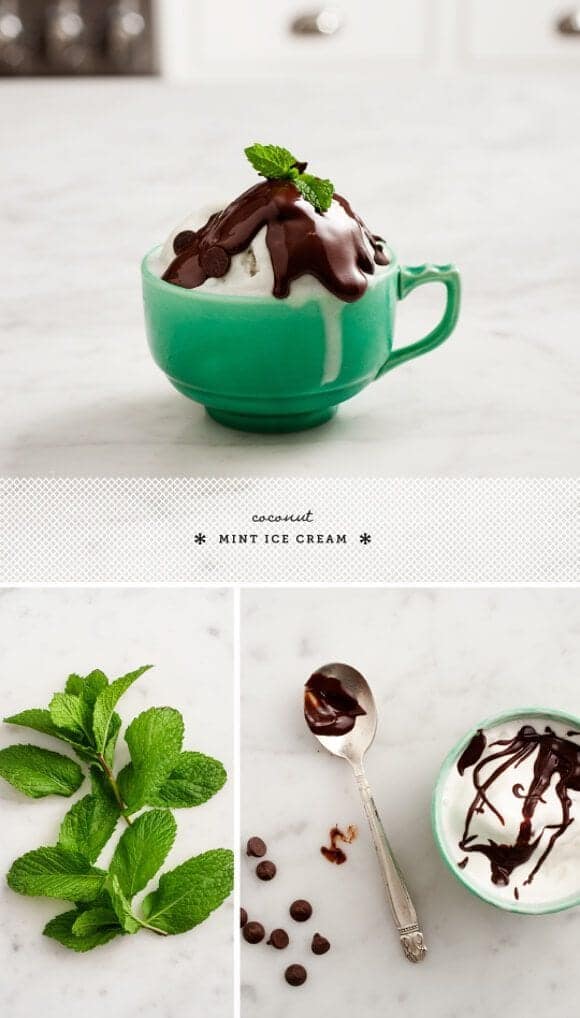
Let me start by saying that mint chocolate chip has never been my top choice. It’s always been my sister’s favorite, I was more of a cookies & cream kind of girl. But this blog makes me try things I might have otherwise not… For example, I bought turnips the other day at the farmers market just because they looked cute. When I saw this green mug, I craved just one thing: Mint ice cream. To my surprise (and Jack’s too), mint ice cream made with fresh mint is amazing! It’s a completely different ice cream flavor altogether. First off, it’s white, not green. The green from the mint doesn’t really rub off and there’s, of course, no food coloring in here. The flavor is so fresh and springy… It tastes like I picked a bunch of mint from the yard and made ice cream out of it. (which is what I did). It’s made with coconut milk, because that’s just the way we do ice cream around here. I also whisked together this chocolate sauce using dark baking chocolate, coconut oil and a bit of agave syrup. As a happy accident… it’s vegan magic shell http://www.loveandlemons.com/
Lightning at Huntaington Beach , Ohio Toad River Valley, Canada Snoqualmie Falls, Washington Grizzly Bear Cubs Antelope Canyon, Arizona Santa Monica Shore Polar Bear and Cubs, Svalbard , Norway Rock Fort , India Whale Shark Arctic Rainbow Owachomo Bridge at Night, Utah Swan on the River Avon King Penguins Swimming Porcupine Mountains Waterfall, Michigan Bottlenose Dolphins in Surf Havasu Creek Waterfall, Arizona Shenandoah Moon Lightning, Superstition Mountains African Elephant, Tanzania Gray Reef Sharks, Kingman Reef Blue Iceberg
The Most Spectacular Contemporary Pools Presented on Fresh home
Montreal Gardens, Phenomenal!!
What amazing creativity. Can you imagine the maintenance?!?
When flowers rain a waterfall 


The Amazon - The greatest river The Amazon is the greatest river in the world by so many measures; the volume of water it carries to the sea (approximately 20% of all the freshwater discharge into the oceans), the area of land that drains into it, and its length and width. It is one of the longest rivers in the world and, depending upon who you talk to, is anywhere between 6,259km/3,903mi and 6,712km/4,195mi long.For the last century the length of the Amazon and the Nile Rivers have been in a tight battle for title of world's longest river. The exact length of the two rivers varies over time and reputable sources disagree as to their actual length. The Nile River in Africa is reported to be anywhere from at 5,499km/3,437mi to 6,690km/4,180mi long. But there is no question as to which of the two great rivers carries the greater volume of water - the Amazon River.At its widest point the Amazon River can be 11km/6.8 mi wide during the dry season. The area covered by the Amazon River and its tributaries more than triples over the course of a year. In an average dry season 110,000 square km of land are water-covered, while in the wet season the flooded area of the Amazon Basin rises to 350,000 square km. When the flood plains and the Amazon River Basin flood during the rainy season the Amazon River can be up to 40km/24.8 mi wide. Where the Amazon opens at its estuary the river is over 325km/202 mi wide!Because the Amazon drains the entire Northern half of the South American continent (approx. 40% landmass), including all the torrential tropical rains that deluge the rainforests, it carries an enormous amount of water. The mouth of the Amazon River, where it meets the sea, is so wide and deep that ocean-going ships have navigated its waters and traveled as far inland as two-thirds the way up the entire length of the river.So, how did the Amazon get to be so big? The first reason has to do with its location - right at the equator. Around the "belt line" of the earth lies a warm, tropical zone where over 400 in/1016cm of rain fall every year. That averages out to more than an inch (3cm) of rain, everyday! A lot of water falls onto the land surrounding the river, what samitha is called the "Amazon River drainage basin". A good way to understand what a drainage basin is to think of the whole northern half of the continent of South America as a shallow dish, or saucer. Whenever rain falls and lands anywhere in the river basin it all runs into the lowest place in the pan, which happens to be the Amazon River. The sheer volume of rain in the Amazon jungle, as well as the slope of the surrounding land, combine to create the enormous river known as the Amazon.
THE VALLEY OF FLOWERS - UTTARAKHAND - INDIA
| Page:
|
|
|
|
|
17 |
|
|
|
|
|
|



