Viewing 280 - 288 out of 370 Blogs.
A tribute to Steve Irwin

Steve Irwin
Steve Irwin , the popular television presenter better known as the 'Crocodile Hunter', has passed away following a marine accident.
The 44-year old was filming an underwater documentary on Monday morning, and police sources in Cairns, north Australia, say he was killed by a stingray barb.
Only the second known Australian fatality from a stingray attack, Irwin seemed to have been stung either through his heart or the left side of his chest, following which he immediately suffered a cardiac arrest. He is survived by wife Terri and their two children, Bindi Sue, 8, and Robert, 3.
Also aiding his global following were his pro-conservation, environmentalist approach and his encyclopaedic knowledge and love of crocodiles.
Australian naturalist and animal-lover Steve Irwin has died after being struck in the chest by a stingray's barb.
Irwin had been filming a documentary on his boat Croc One in Queensland's Great Barrier Reef on the day of his death. Paramedics were unable to save his life.
The 44-year-old was famous around the world for handling dangerous animals, including an anaconda during a TV appearance on the Jay Leno Show.
Mr Irwin's wife Terri was often at his side, to help deal with animals such as the albino Burmese python.
Father-of-two Mr Irwin grew up on his parents' reptile park and became fascinated with animals after receiving a python as a present on his sixth birthday.
He was also a passionate conservationist and was pictured with a variety of animals, such as Kimberly the camel in 2003.
There was outrage in 2004 when Mr Irwin held his one-month-old son near a crocodile during a show. He said his children, including daughter Bindi, had to grow up to be "croc savvy".
Mr Irwin, who handled dangerous animals such as the taipan snake, turned a small reptile park in Queensland into Australia Zoo. It has now become a major wildlife centre.
And Mr Irwin emphasised his dedication to saving endangered species by creating the Steve Irwin Conservation Foundation.
Australian Foreign Minister Alexander Downer said he was "fond" of Mr Irwin and "very, very appreciative" of his work in promoting Australia overseas.
Fans left flowers at Australia Zoo after news of Mr Irwin's death was confirmed on Monday.
Stingray Pic
10 Most Captivating Deserts
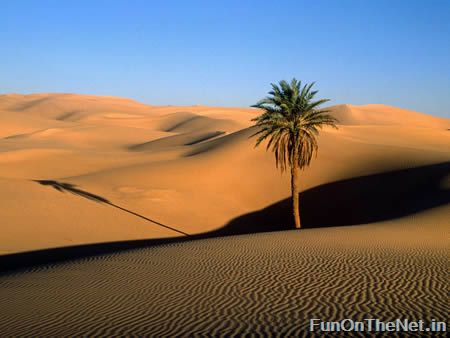
Here are 10 of the most Captivating and Bretahtaking Deserts! From the Sahara, the worlds largest to the Farafra in Egypt and even the Taklamakan, a desert covered with snowfall!

Taklamakan (Central Asia): a desert covered with snowfall
Taklamakan is one of the largest sandy deserts in the world, ranking 15th in size in a ranking of the world's largest non-polar deserts. It covers an area of 270,000 km2 (100,000 sq mi) of the Tarim Basin, 1,000 kilometres (620 mi) long and 400 kilometres (250 mi) wide. It is crossed at its northern and at its southern edges by two branches of the Silk Road as travelers sought to avoid the arid wasteland.
In 2008, China's biggest desert experienced its biggest snowfall and lowest temperature after 11 consecutive days of snow. Snow is rare in the desert that covered 337,600 square kilometers, never before had the whole desert been covered.
Lençóis Maranhenses (Brazil): a ‘desert' with lagoons
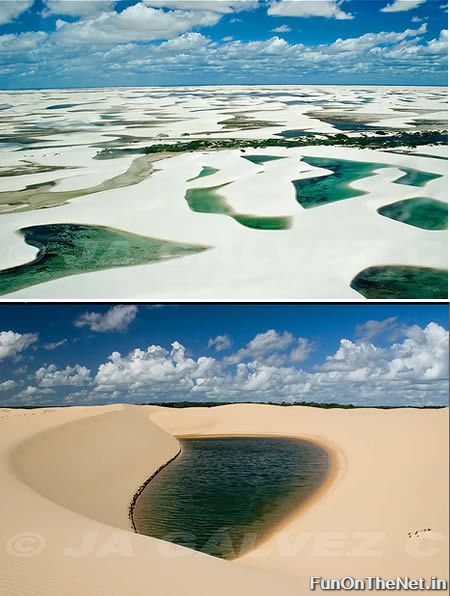
It seems incredible, but in a country that keeps around 30% of the fresh water and shelters the largest rain forest in the world, we can find a “desertâ€. Located in the State of Maranhão, on the north shore of Brazil, the Lençóis Maranhenses National Park is an area of about 300 square kilometers (155,000 ha) of blinding white dunes and deep blue lagoons, forming one of the most beautiful and unique places in the world. The dunes invade the continent over 50km (31 miles) from the cost, creating a landscape that reminds a white bed sheet, when seen from above.
But you may ask: -Lagoons?? You told me it was a desert… Yes, what defers this region from a desert is the amount of rain that drops over the dunes, creating ponds of crystal clear water on the depression between dunes. Despite its desert-like appearance, Lençóis Maranhenses records an annual rainfall of 1,600mm (i.e. 62.9 inches), 300 times more than in the Sahara. During the period of drought, the lagoons evaporate and become completely dried. After the rainy season, the lagoons are home of many species of fish, turtles and clams. The mystery in this story lies in the fact that when the lagoons fill up, life comes back, as if they had never left the place. One of the hypotheses to explain the phenomenon is that the eggs of the fish and crabs are maintained alive in the sand, exploding when rain comes back.
Salar de Uyuni (Bolivia): the world's largest salt desert
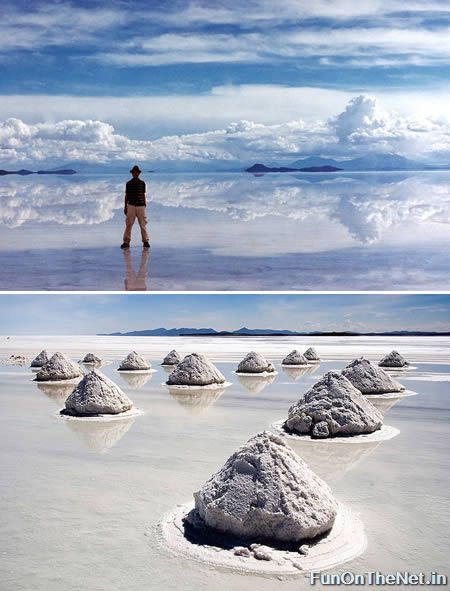
The Salar is one of the iconic images of Bolivia, a massive salt desert in the middle of the Altiplano. It is an expansive, virtually flat desert that reflects the sun in such a way as to create a mirror effect with the sky. There are several lakes in the desert with strange colours from the mineral deposits in the region.
Some 40,000 years ago, the area was part of Lake Minchin, a giant prehistoric lake. When the lake dried, it left behind two modern lakes, Poopó Lake and Uru Uru Lake, and two major salt deserts, Salar de Coipasa and the larger Uyuni. Uyuni is roughly 25 times the size of the Bonneville Salt Flats in the United States. It is estimated to contain 10 billion tons of salt, from which less than 25,000 tons is extracted annually.
Farafra (Egypt): the white desert
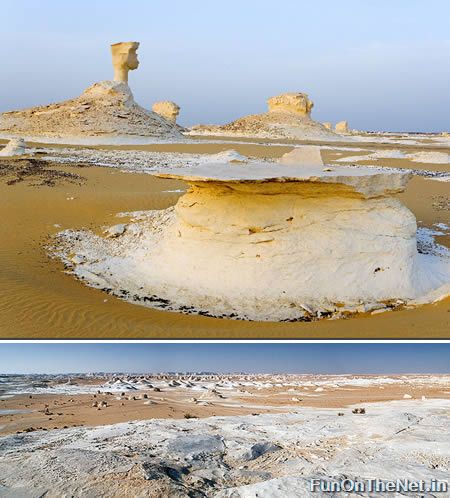
A main geographic attraction of Farafra is its White Desert (known as 'Sahara el Beyda,' with the word 'sahara' meaning a desert). The White Desert of Egypt is located 45 km (30 miles) north of Farafra. The desert has a white, cream color (it is truly white, in clear contrast with the yellow deserts elsewhere) and has massive chalk rock formations that have been created as a result of occasional sandstorms in the area.
Atacama (Chile): the flourished desert
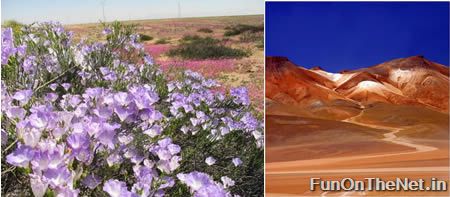
The Atacama Desert occupies the largest amount of the Chilean territory located north of the 29th parallel. The area located on the coast between Arica and Antofagasta appears in the Guinness Book of World Records as the driest place in the world. Nevertheless, to the south of the Tropic of Capricorn, the desert becomes kinder towards living beings. The coastal mists, "camanchacas", are more abundant south of Antofagasta and bring the humidity necessary for the maintenance of the coastal scenic vegetation. Many plants survive mainly because of the "camanchaca", and the harsh savings of water, in normal dry years, that causes them to delay important functions such as growth, to favor survival and reproduction. (Link)
Namib (Namibia): the only desert with elephants
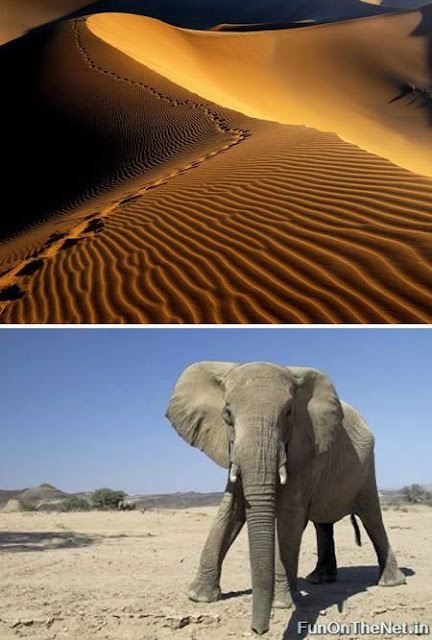
South of Africa lies the Namib desert. which is less vast than the Sahara but just as impressive. It forms part of the Namib-Naukluft National Park with neighbouring Angola. The Sossusvlei sand dunes are the highest in the world, some towering at 300m high and if you are lucky enough, you can stumble across desert elephants-the Namib is the only desert in the world to have elephants. Apparently the oldest desert in the world, myriad species of plants and animals can only be found here. The Namib has fascinated geologists for years but it remains very little understood to this day. Off the coast, strong southerly winds with fogs and strong currents cause sailors to lose their way; the north coast has been named 'Skeleton Coast' due to the amount of shipwrecks found there, some of which can be found as much as 50m inland, as the desert slowly takes over the ocean as it moves westwards.
Simpson Desert (Australia): the red sand desert
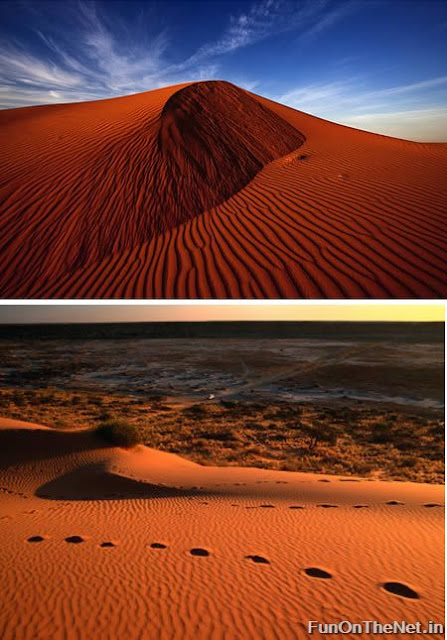
Australia is home to four large deserts, popularized by Mad Max: Sturt's Stoney Desert, Tanami Desert, the Great Victoria Desert and the Simpson Desert, which is also known as 'The Big Red' due to the presence of dunes of red sand. The Simpson Desert is an erg which contains the world's longest parallel sand dunes. These north-south oriented dunes are static, held in position by vegetation. They vary in height from 3 metres in the west to around 30 metres on the eastern side. The most famous dune, Nappanerica, or, more popularly, Big Red (named by Simpson Desert traveller Dennis Bartell), is 40 metres in height.
The Black Desert (Egypt): the desert with black stones
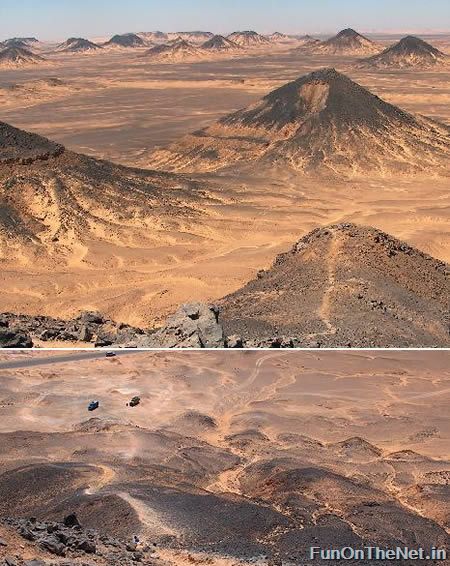
Located 100km northeast of the White desert, the Black Desert is a region of volcano-shaped mountains with large quantities of small black stones. The stones lie out across the orange-brown ground, so that it is not quite as black as many people may hope for. Especially after visiting the White Desert, which has formations that are really white, many will imagine a desert as dramatic as this. Climbing one of the many soft peeks, the view from the top is really nice, with similar peeks continuing on into the haze. The Black Desert is uninhabited. (Link)
Antarctica: world's driest and wettest desert
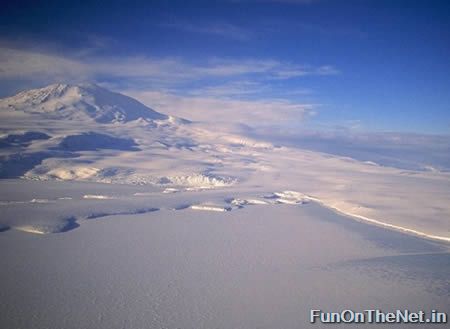
Antarctica is a land of extremes. It's not inhabited year round by humans because it's simply too freezing cold. In 1983 scientists recorded extreme cold temperatures as low as -129 Fahrenheit. It's also the wettest place on Earth, but simultaneously the driest. The reason it's the “wettest†is not because of rainfall; since Antarctica is covered by 98% ice, it's technically very wet. However since it's also the aforementioned coldest place in the world, it gets very little precipitation – less than 2 inches a year. Which makes Antarctica a desert. A brutally cold ice desert with a massive trench full of even more…ice. Three for the price of one!
Sahara (North Africa): world's largest desert
The Sahara, with a size of 8.6 million km², is the world's largest desert, covering large parts of North Africa. Around 4 million people live there. Its maximum length is 4,800 km, running from west to east, and up to 1,200 km from north to south. Sahara covers most of Mauritania, Western Sahara, Algeria, Libya, Egypt, Sudan, Chad, Niger and Mali, and touches Morocco and Tunisia.
Sahara is very dry but there is an annual rainfall in most regions, although just a few dozen millimetres.
( 18 Votes )
Looking for a good venue is top of most bride-to-bes' to do list, but selecting somewhere that stands out from the rest is easier said than done. Long gone are the days when a simple hotel buffet was a priority in a wedding. Nowadays weddings lay emphasis on personality of the bride and groom. It's becoming difficult to find someplace that's really unique-but not impossible. Below are some of the weird and wonderful places to tie the knot.
1.The Film Studio
The world famous Pinewood Studios, the location for a host of box office hits including many James Bond films has been used as a wedding venue too! You can choose to spread your wedding across both the original manor house and specific film or TV studios. Get ready with a pose!


2.The Treehouse
The Lodge will drift your guests back to their childhood with its delightfully rustic treehouse overlooking Loch Goil in Scotland. It's an intimate and romantic venue with sweeping mountains and lake views with a room just enough for 25 people.


3.The Old Swimming Pool
The Decorium is a unique building that began its life in 1895 with an idea to provide a public swimming pool for the local community. It is a neo-classically designed complex inspired by Roman architecture. Located in north London, this venue will dazzle your guests wih the elegant foyer entrance and 5,500 square foot "Emperor Suite" dating back to 1895.


4.The Dinosaur Museum
Few couples could claim to have exchanged vows within the shadows of a T Rex, but at the Great North Museum in Newcastle that's exactly what you can do! Newlyweds can also opt to tie the knot amidst the museum's Ancient Egyptian mummies.

5.The Art Gallery
Have you ever considered getting married in an art gallery? Why not say "I do" in the company of some of history's finest masterpieces? Well, now you can in Laing Art Gallery, Newcastle.


6.The Inner City Warehouse

 Jorge Mario Bergoglio, who was named Pope Francis on Wednesday, at the El Salvador school, where he taught literature and psychology in Buenos Aires, Argentina, in 1966. AP Photo/El Salvador School